




In the Central African Republic, no mining activity is possible without a title. Prospecting, exploration, artisanal or industrial mining: each stage of a project requires a specific authorisation issued by the mining administration. Here is how to find your way.
The principle: one title for each stage
The Mining Code distinguishes titles according to the nature of the work and the scale of the project. Broadly, they are:
- the prospecting authorisation, for initial reconnaissance of an area;
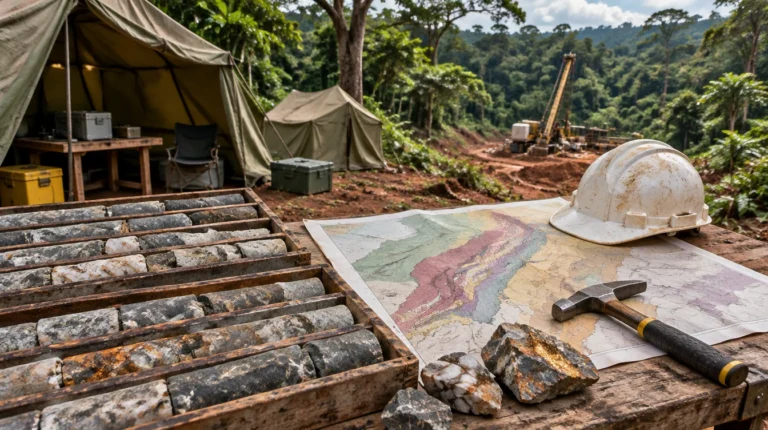
- the exploration permit, giving the exclusive right to explore an area to delineate a deposit;
- the industrial mining licence, for a large or medium-sized mine;
- the semi-mechanised artisanal mining permit, for small-scale mining using light equipment;
- the artisanal mining authorisation, reserved for artisanal miners;
- quarry authorisations, for construction materials.
The Mining Code adopted in 2024 modernised this framework. The precise durations, areas and obligations of each title are set by the code and its implementing texts: check the official version before filing anything. See our summary of the Central African Mining Code.
Who can apply for a title?
Industrial titles are open to companies, including foreign-owned ones, that can demonstrate sufficient technical and financial capacity. Artisanal mining, by contrast, is traditionally reserved for Central African nationals and their cooperatives. A foreign investor wishing to work in the artisanal segment therefore does so in a support role (equipment, financing, purchasing), not as a direct operator.
Several cooperatives were suspended in 2026 over partnerships with foreigners deemed irregular. Any collaboration with artisanal miners or cooperatives must be structured in strict compliance with the rules.
The steps of an application
The typical path for an industrial project includes:
- setting up a company under Central African law or regularising a foreign company’s presence (see our guide to starting a business in the Central African Republic);
- checking the availability of the area with the mining administration, as there is no public digital cadastre;
- preparing the file: area coordinates, work programme, budget, technical references, financial evidence;
- filing the application and paying the fixed fees;
- carrying out the required studies, including the environmental and social impact assessment before mining;
- negotiating, where applicable, a mining agreement with the State setting out commitments and the applicable regime.
Obligations once the title is granted
A mining title is not just a right: it comes with commitments. The holder must carry out the planned work programme, pay area fees and taxes, report regularly to the administration, comply with the new code’s transparency obligations and, at the end of mining, rehabilitate the site.
Unused titles can be withdrawn. The EITI has encouraged Bangui to clean up its register by cancelling the permits of inactive companies.
Points of vigilance
- Overlapping titles: an area may be subject to competing claims, notably with existing artisanal operations.
- Security in the area, which determines whether work is feasible at all.
- Relations with communities, to be built from the exploration stage.
- Traceability of production, now at the heart of inspections.
Since 2021, dozens of permits have been granted, including more than 50 new industrial titles in 2025 according to official documents analysed by the NGO IPIS. The market is active, but the administration is more demanding about the seriousness of title holders.
SCADIS helps project developers prepare their applications and connects them with the right professionals. Discover our Mining in the Central African Republic page and our overview of the country’s mineral resources.
Frequently asked questions
What are the mining titles in the Central African Republic?
Mainly the prospecting authorisation, exploration permit, industrial mining licence, semi-mechanised artisanal mining permit, artisanal mining authorisation and quarry authorisations.
Can a foreigner obtain a mining permit in the Central African Republic?
Yes for industrial titles, through a company with technical and financial capacity. Artisanal mining is reserved for nationals and their cooperatives.
Is there an online mining cadastre in the Central African Republic?
Not yet. The availability of an area must be checked with the mining administration.
Sources: FAO / FAOLEX, CAR Mining Code (2009) · IPIS, mining permits in the CAR (June 2026) · EcoMatin, cooperatives suspended (March 2026) · EcoMatin, EITI and inactive permits (Feb. 2026). Information current as of 21 November 2026.