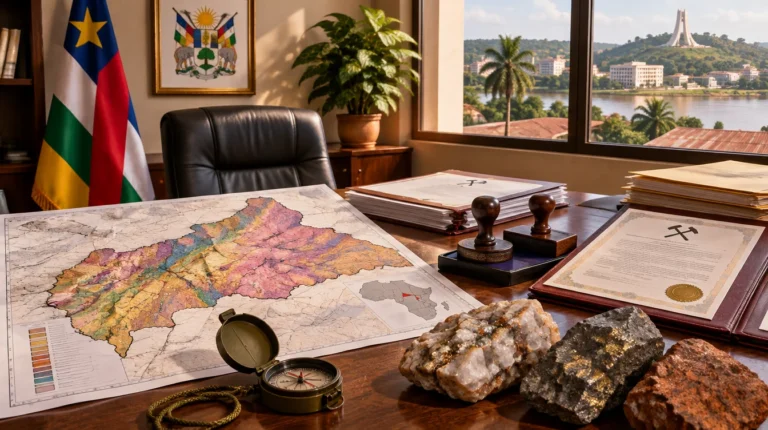










Adopted in 2024 after three years of preparation, the new Mining Code of the Central African Republic redefines the rules of the sector: greater transparency, a new state company and revenue sharing with local authorities. Here are the essentials for an investor.
Why a new Mining Code
In preparation since 2021, the text was adopted by the National Assembly in May 2024 and replaces the previous code. It meets three objectives: better regulating a largely artisanal sector, increasing state revenue and strengthening the traceability of gold and diamonds, a precondition for access to international markets.
The context has also moved fast: a few months after the code was adopted, the Kimberley Process fully lifted the embargo on Central African diamonds. Read our article on the lifting of the Kimberley embargo.
The main changes
A state company: GEMINCA
The code provides for the creation of Gemmes et minéraux de Centrafrique (GEMINCA), set to play a leading role in mining value chains, with a monopoly on export activities. For a private operator, this means marketing and export channels will have to work alongside this body.
Revenue sharing
Article 172 sets out how mining revenue is shared: 20% for decentralised local authorities and up to 80% for the State. The aim is for producing regions to benefit directly from mining.
Transparency obligations
The new code introduces a set of transparency rules for companies in the sector: publication of information, declaration of payments and traceability of production. These requirements are in line with those of the Extractive Industries Transparency Initiative (EITI), of which the Central African Republic is a member.
Mining titles and their conditions
As in most Central African mining codes, activity is governed by separate titles depending on the stage and scale of the project: prospecting authorisation, exploration permit, then mining licence, whether industrial or semi-mechanised artisanal. Each title sets a duration, an area, work obligations and renewal conditions.
Before taking any step, have a lawyer check the official version of the Mining Code and its implementing texts: the precise conditions for award, duration and taxation are set out there.
Implementation still in progress
Two years after its adoption, the code is still not fully implemented: the IMF has called on the authorities to apply it in full, and the announced state companies are slow to start. For an investor, this creates a transition period to be handled with care: the rules are in place, but some institutions are not yet fully operational.
The stages of a mining project
- Identify the area and check its availability with the mining administration.
- Set up a suitable legal structure and assemble the technical and financial capacity.
- File the title application and carry out the required studies, including the environmental and social impact assessment.
- Negotiate commitments with the State and local communities.
- Put traceability and compliance in place from day one.
SCADIS supports mining projects in compliance with the Mining Code and international standards. Discover our Mining and natural resources page and our article on gold in the Central African Republic.
Frequently asked questions
When was the new Central African Mining Code adopted?
It was adopted by the National Assembly in May 2024, after work began in 2021.
What is GEMINCA?
Gemmes et minéraux de Centrafrique is the state company created by the 2024 Mining Code, set to play a central role in mining value chains, with a monopoly on exports.
How is mining revenue shared in the Central African Republic?
Article 172 of the Mining Code allocates 20% of revenue to decentralised local authorities and up to 80% to the State.
Sources: EcoMatin, Mining Code adoption and GEMINCA (June 2024) · EcoMatin, one year after the Mining Code · EcoMatin, state mining companies (2026) · EITI, contract transparency in the CAR. Information current as of 20 November 2026.