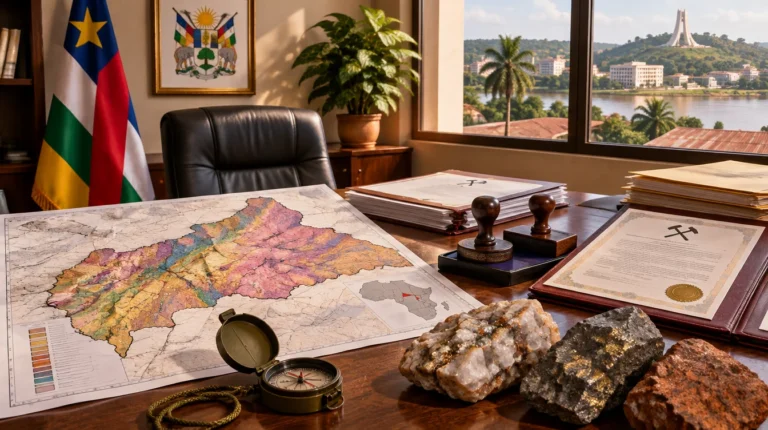


The Central African Republic is often associated with gold and diamonds. Yet its subsoil is far more varied: more than 500 mineral occurrences have been recorded, covering some thirty substances. Here is a deposit-by-deposit map of the country’s mining potential.
A potential still largely unexplored
According to the Ministry of Mining and Geology, the Central African Republic has around 34 mineral substances spread over more than 520 occurrences. At the end of 2024, the head of state announced the discovery of 49 new occurrences around Boali and Gontiguiri, bringing the total to 519 against 470 previously: figures vary between inventories, but the order of magnitude is the same.
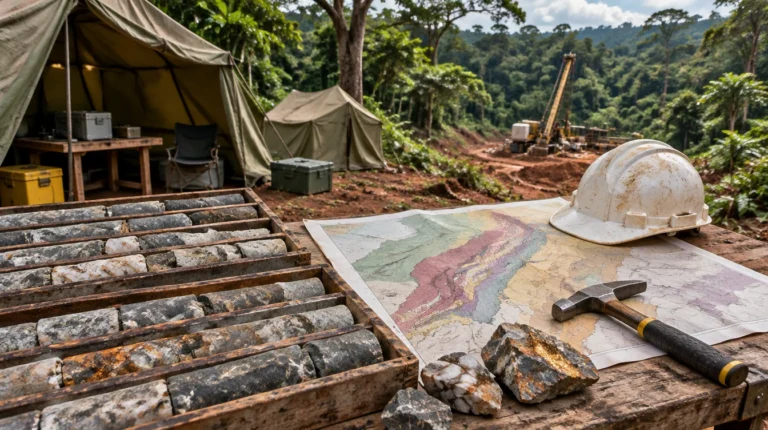
Around 60% of the territory is thought to have significant mineral potential, and much of it has never been surveyed in detail. This is one reason the State is now turning to new tools: drones, satellite imagery and airborne exploration campaigns.
Precious resources
Gold
In 2025, gold became the country’s leading export. According to the BEAC, official exports rose from 770 kg in 2024 to 7.41 tonnes in 2025, and the central bank expects around 8 tonnes in 2026. Production is mostly artisanal and alluvial, notably in the west (Nana-Mambéré, Mambéré-Kadéï), the centre and the east. The Ndassima deposit, in the centre, is one of the few primary gold projects identified. Read our article on gold in the Central African Republic.
Diamonds
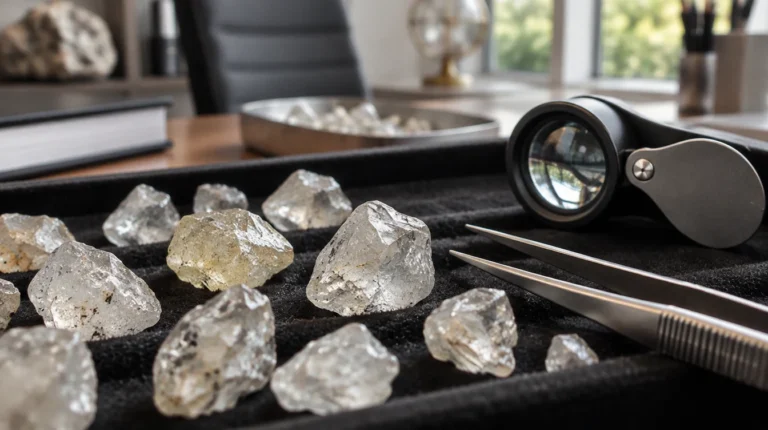
Alluvial diamonds come mainly from two large areas: the south-west (Berberati, Carnot, Nola basin) and the north-east (Haute-Kotto). In November 2024 the Kimberley Process lifted all export restrictions. Production nevertheless remains almost entirely artisanal, and the BEAC expects a sharp fall in 2026. See our analysis of the lifting of the Kimberley embargo.
Bakouma uranium
The Bakouma deposit, in the south-east (Mbomou prefecture), is the best known of the country’s non-gold deposits. Published estimates vary widely, from about 32,000 to more than 50,000 tonnes of uranium depending on the source. Taken over by several operators since the 2000s, it has never been mined. It is again attracting international interest, notably under the agreement signed with the Canadian group CVMR.
Metallic resources
Iron
The Bogoin iron deposit, north-west of Bambari, has long been known: the ministry refers to a lens of about 3.5 million tonnes at high grade. A far more ambitious project covering the Bakala/Topa and Bogoin deposits has been announced, targeting resources of up to 20 billion tonnes: a figure to treat with caution until exploration results are published.
Copper, nickel, cobalt and more
Ngadé copper is among the occurrences cited by the ministry. Since 2021, some twenty large exploration permits have been granted for critical and strategic minerals: lithium, cobalt, nickel, copper and uranium. Coltan, tin, manganese, rutile and graphite are also among the substances recorded.
Energy and industrial substances
- Nzako lignite, in the east, a potential energy resource;
- Bobassa limestone, of interest for lime and cement production;
- construction materials (sand, gravel, clay, stone), essential for building sites in Bangui and provincial towns.
These quarry materials are often overlooked, yet they meet immediate local demand and require more accessible investment than large mining projects.
Key points before investing
- The potential is real but still poorly documented: the quality of geological data is the first thing to check.
- There is no public digital mining cadastre yet: information on titles is obtained from the administration.
- The legal framework was overhauled in 2024: read our summary of the Central African Mining Code.
A mineral occurrence is not a deposit. Between discovering an occurrence and a profitable mine lie years of exploration, studies and investment.
SCADIS helps investors identify and assess mining opportunities: discover our Mining in the Central African Republic page.
Frequently asked questions
What are the main mineral resources of the Central African Republic?
Gold and diamonds are the most exploited. The country also has uranium (Bakouma), iron (Bogoin), copper, lignite, limestone and strategic minerals that are still little explored.
How many mineral occurrences does the Central African Republic have?
More than 500 occurrences are recorded, covering some thirty substances. The head of state cited 519 occurrences at the end of 2024, after 49 new discoveries.
Does the Central African Republic produce uranium?
No. The Bakouma deposit has been known for decades but has never been mined.
Sources: Ministry of Mining, extractive industry factsheet · Ministry of Mining, SEMICA 2020 · EcoMatin, transparency and mineral occurrences (2025) · EcoMatin, 2026 diamond output (BEAC) · IPIS, mining permits in the CAR (June 2026) · EcoMatin, Bakala/Topa and Bogoin iron project · EcoMatin, Bakouma uranium. Information current as of 21 November 2026.