




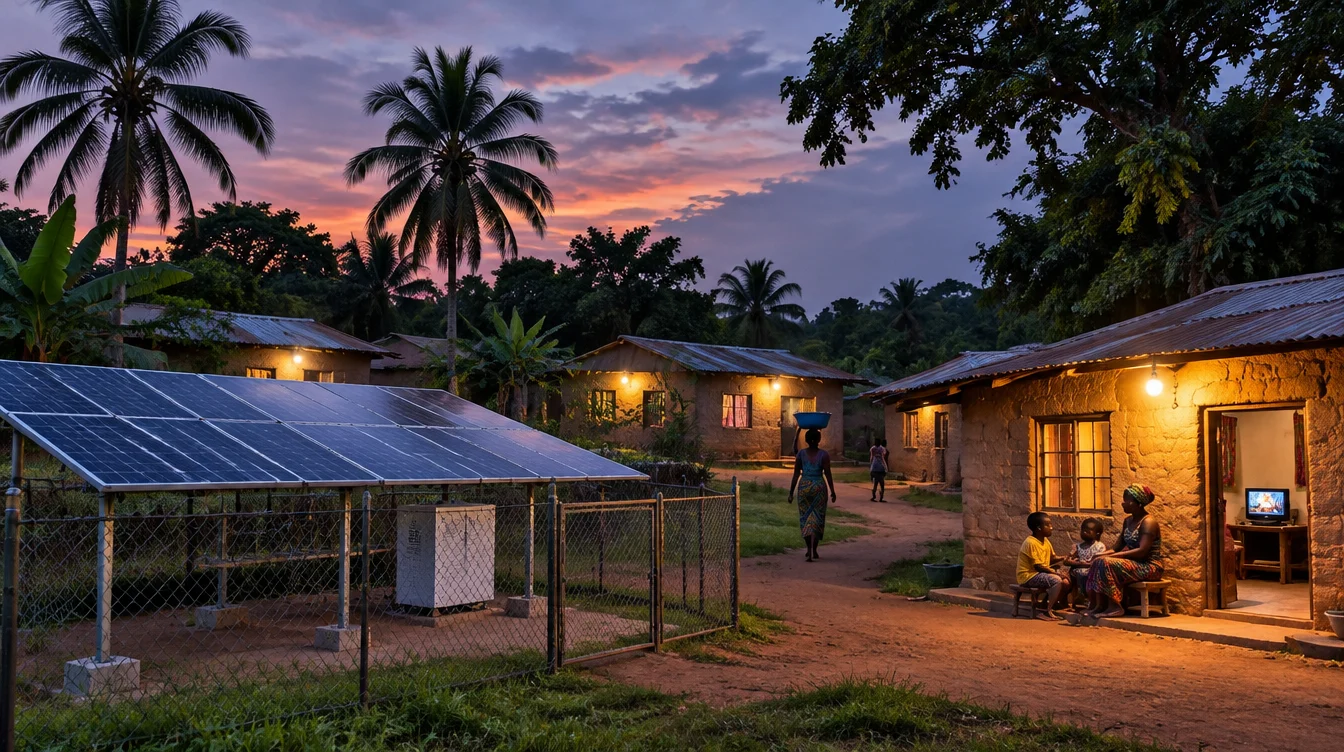
Fewer than one in five Central Africans has access to electricity, and the national grid is concentrated around Bangui and Boali. For provincial towns, villages, farms and mining sites, off-grid solutions are often the only realistic option.
Areas without a grid
The Central African power grid essentially serves the capital and its surroundings. Much of the country has no supply at all: prefectures, secondary towns, rural areas. These communities rely on costly generators, kerosene lamps or small individual solar devices.
The government has set a target of 50% access to electricity by 2030. The large Danzi and Sakaï solar plants are strengthening supply to Bangui; to reach the national target, decentralised electrification is essential. Read our article on solar energy in the Central African Republic.
Mini-grids and solar kits
Two broad families of solutions coexist:
- solar mini-grids: a plant of a few tens to a few hundred kilowatts, with batteries, supplies a village or neighbourhood through a local distribution network. They suit small towns and business hubs;
- individual systems: solar home kits, solar pumps, solar refrigerators for health centres or shops.
Hybrid mini-grids, combining solar, storage and a backup generator, guarantee continuous service while sharply reducing fuel consumption.
A mini-grid’s success depends as much on the business model as on the technology: suitable tariffs, prepaid meters, local maintenance and productive uses that guarantee demand.
The needs of agricultural and mining sites
Productive sites are often the first customers of an electrification project: agricultural processing units (cassava, coffee, oil), cold rooms, irrigation pumping, mining sites and camps. A plant sized for a business site can also supply neighbouring communities, which strengthens the project’s acceptance and profitability.
Financing an electrification project
Several sources of finance can be combined:
- programmes of international donors, such as the World Bank, already active in the Central African power sector;
- funds dedicated to energy access and climate;
- private investment, backed by revenue from electricity sales;
- payments from anchor productive sites (factory, mine, farm).
Reforms under way in the sector, such as the sharp cut in connection costs announced by the public electricity company, show a will to broaden access.
Keys to a successful project
- A study of actual demand, village by village or site by site.
- Prudent sizing, expandable as consumption grows.
- Robust equipment, suited to the climate and to local maintenance.
- Training technicians on site.
- A clear contractual framework with the authorities and communities.
SCADIS supports renewable energy and electrification projects in the Central African Republic: discover our Energy and sustainable development page and our article on cassava processing, an example of productive use of energy.
Frequently asked questions
What is the electrification rate in the Central African Republic?
Less than 18% of the population has access to electricity, and the grid is concentrated around Bangui. The government is aiming for 50% access by 2030.
What is a solar mini-grid?
A small solar plant, usually with batteries, that supplies a village or neighbourhood through a local distribution network, independent of the national grid.
How can a mini-grid be financed in the Central African Republic?
By combining donor programmes, energy access funds, private investment and contracts with productive customers such as factories, farms or mines.
Sources: Financial Afrik, electricity access and 2030 target (Aug. 2026) · EcoMatin, Sakaï 2 and electricity access · World Bank, Danzi plant. Information current as of 20 November 2026.