

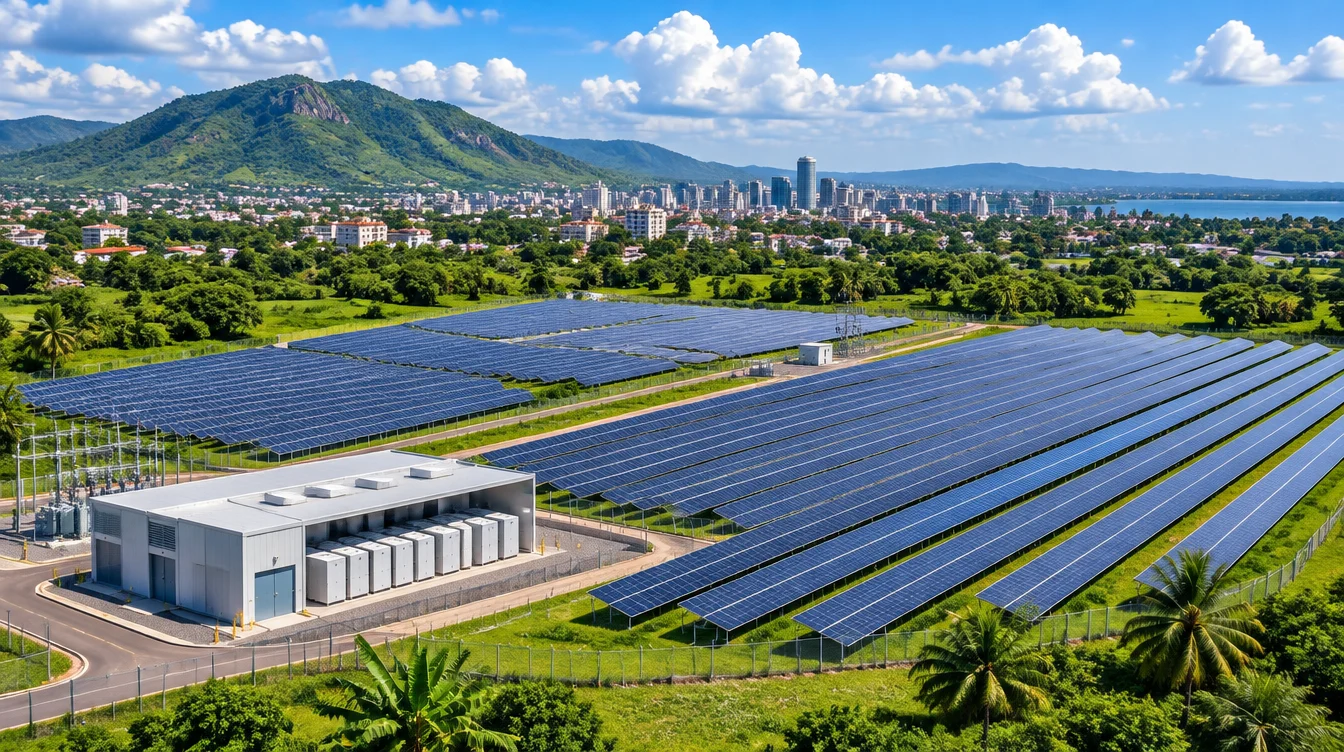
In three years, solar power has profoundly changed the electricity landscape of the Central African Republic. The Sakaï and Danzi plants have sharply increased generation around Bangui. For businesses, however, energy remains a critical cost item, and an opportunity.
Access to electricity in the Central African Republic
The country is starting from a low base: less than 18% of the population has access to electricity, one of the lowest rates on the continent. The grid is concentrated around Bangui and Boali, leaving much of the country unserved. Peak demand in Bangui alone is estimated at around 200 MW, and the government is aiming for 50% access to electricity by 2030.
Boali, Danzi, Sakaï: the country’s power plants
Boali hydropower
Historically, Central African electricity has come from the Boali dams on the Mbali river: Boali 1, commissioned in 1955, and Boali 2, in 1976, each of around ten megawatts, supplemented by Boali 3. These ageing facilities can no longer meet demand.
Sakaï 1 and Danzi: the first solar plants
The Sakaï 1 plant (15 MW) was commissioned in 2023. It was followed in November 2023 by the Danzi plant: 25 MW with battery storage, about 18 kilometres from Bangui, financed with World Bank support. According to the World Bank, Danzi replaces more than 90% of the electricity previously generated from diesel, saving around USD 4 million a year.
Sakaï 2: a change of scale
In August 2026, the Sakaï 2 solar plant, built by the Emirati group Global South Utilities, was connected to the national grid. It is coupled with a battery storage system and is set to improve supply to Bangui, Bimbo and neighbouring towns. In parallel, 110 kV high-voltage lines between the Danzi and Sakaï substations strengthen power transmission.
Despite this progress, supply still falls short of needs and power cuts persist. For a sensitive activity (cold storage, processing, data, healthcare), energy autonomy remains an issue to address from the project design stage.
What this means for businesses
The rise of solar reduces dependence on diesel and makes the grid more reliable in Bangui. But for most industrial, agricultural or mining sites located off-grid, energy is still an open question. Businesses have three models to choose from:
- grid connection in Bangui, backed up by a standby solution;
- solar for self-consumption on rooftops or ground-mounted, with batteries, to cut the fuel bill;
- a dedicated plant or mini-grid for an isolated site (factory, farm, mine).
Private solar and storage: key points
- Size the installation on actual needs, including consumption peaks.
- Provide battery storage to cover evenings and fluctuations.
- Keep a generator as backup, but reduce its running time.
- Plan for maintenance: spare parts, local skills, service contracts.
- Build the cost of energy into the business plan over the full life of the project.
SCADIS supports renewable energy projects and the power supply of business sites in the Central African Republic. Discover our Energy and sustainable development page and our article on rural electrification and mini-grids.
Frequently asked questions
What is the rate of access to electricity in the Central African Republic?
Less than 18% of the population has access to electricity. The government is aiming for 50% by 2030.
What solar plants does the Central African Republic have?
Sakaï 1 (15 MW, 2023), Danzi (25 MW with batteries, 2023) and Sakaï 2, connected to the grid in August 2026, all located near Bangui.
Is solar power profitable for a business in the Central African Republic?
For a site that depends on diesel, solar with batteries sharply reduces fuel consumption. Profitability depends on sizing and actual needs.
Sources: World Bank, Danzi plant (Nov. 2023) · EcoMatin, Sakaï 2 commissioning (Aug. 2026) · Connaissance des énergies / AFP (Aug. 2026) · Financial Afrik (Aug. 2026) · Khaleej Times (Aug. 2026) · Wikipedia, power stations in the CAR. Information current as of 20 November 2026.