









The country’s second-largest export after gold, timber in the Central African Republic is entering a pivotal period: the regional ban on log exports is approaching, the forest code is due for revision and traceability is drawing growing international scrutiny. For investors, these three trends point to both an industrial opportunity and a higher bar of requirements.
An export sector dominated by logs
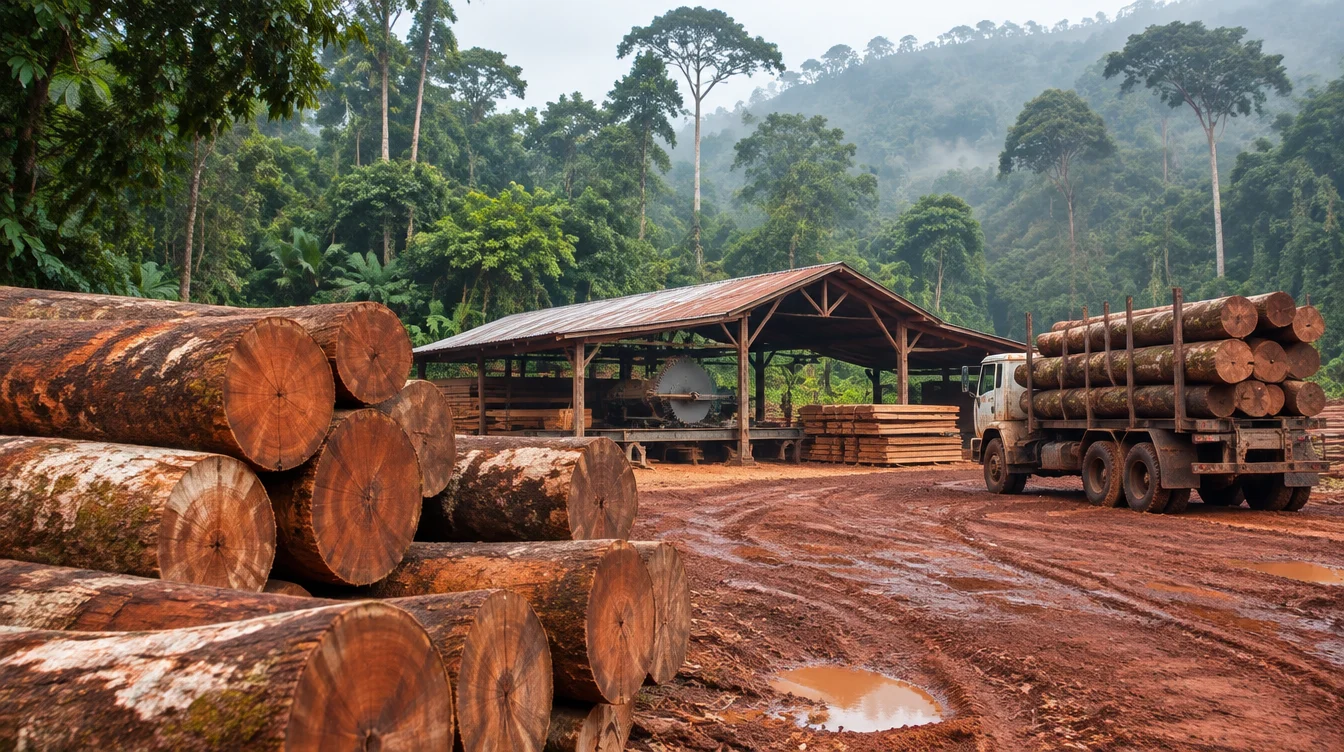
According to the Ministry of Finance’s information note on the government securities market, reported by EcoMatin on 18 February 2026, log exports generated 26.26 billion CFA francs in 2025, up 4.5%. Export volumes reached 204,642 m³ (+4.3%), while production edged down to 610,344 m³ (−1.1%).
In 2023, raw and sawn timber accounted for 14.1% of the country’s total exports, just behind gold. According to data cited by EcoMatin in August 2025, around 90% of Central African timber still leaves the country unprocessed, and the sector employs more than 4,000 people.
The CEMAC 2028 deadline: a turning point for processing
The regional ban on log exports, postponed several times, is now expected to take effect on 1 January 2028. Gabon has applied it since 2010, Congo since 2023 and Equatorial Guinea since February 2026; Cameroon, Chad and the Central African Republic have yet to comply.
Yet local processing remains limited: only 5 of the 13 forestry companies process their logs on site, or 38.5%, far below the regulatory threshold of 70%. This gap raises questions about the country’s readiness, but it also signals a need for investment in sawmilling, drying, veneer and industrial joinery.
A window for the timber industry
The sector plan presented in August 2025 under the 2024-2028 National Development Plan aims to raise the sector’s revenues from 28 to 70 billion CFA francs by 2028. It mentions tax relief, VAT exemptions, preferential-rate loans and faster permit processing through the one-stop shop for business formalities (GUFE). The actual terms of these incentives must be verified on a case-by-case basis.
Forest code reform and transparency
The government plans to revise the forest code in 2026 under the leadership of the Directorate General of Water and Forests, EcoMatin reported on 19 March 2026. The aim is to boost extractive revenues, which the IMF projects at 177.1 billion CFA francs in 2026, including 81.1 billion from the forestry sector.
The latest report of the Extractive Industries Transparency Initiative (EITI) highlights a structural weakness: there is no legal framework for the register of forest titles, which is kept on a basic office software tool, with no permit history or expiry dates. For investors, this calls for thorough due diligence on the validity of titles before any acquisition or partnership.
Traceability and international compliance: a risk to factor in
On 10 November 2026, Reuters reported on a study by the US NGO The Sentry, which denounces a lack of transparency and the presence of sanctioned actors in the sector. The European Union currently classifies the Central African Republic as “low risk” under its deforestation regulation; The Sentry is calling for a move to “standard risk”, which would require importers to carry out more due diligence.
The report notes that the company Bois Rouge was sanctioned in 2024 by the US Treasury, then by the United Kingdom, and states that its concessions have not been revoked. Neither the authorities nor the company had responded to Reuters’ requests for comment. Whatever the outcome of this debate, European and American buyers will demand documented traceability: compliance is becoming a commercial criterion as much as a regulatory one.
Opportunities and points of caution for investors
Opportunities lie mainly downstream: processing units close to logging areas, logistics for sawn timber to Douala, certification and traceability services. Forest covers more than 22 million hectares, and annual forest cover loss remains limited according to data cited by EcoMatin.
Risks stem from the country’s landlocked position, the cost of energy for sawmills, regulatory uncertainty linked to the forest code reform and reputational risk. An audit of titles, verification of partners’ beneficial owners and a sanctions compliance policy are essential. Our method to find a reliable local partner fully applies to this sector.
Key takeaways
- 2025 log exports: 26.26 billion CFA francs (+4.5%) for 204,642 m³.
- CEMAC ban on log exports expected on 1 January 2028.
- Only 5 of 13 companies process locally, against a regulatory threshold of 70%.
- Forest code revision planned for 2026; according to the EITI, the register of titles still needs to be made reliable.
- Traceability and sanctions compliance are becoming conditions for access to Western markets.
Frequently asked questions
When will log exports be banned in the Central African Republic?
The regional ban decided within CEMAC is expected on 1 January 2028, after several postponements. Gabon, Congo and Equatorial Guinea already apply it.
What incentives exist for processing timber locally?
The sector plan announced in 2025 mentions tax relief, VAT exemptions, preferential-rate loans and fast-tracked procedures through the GUFE. Their practical application must be verified project by project.
What checks should be carried out before investing in a forest concession?
You need to verify the validity and history of the title, the identity of the beneficial owners, the absence of links with sanctioned entities and the ability to document the traceability required by buyers.
The Central African timber sector is thus at a turning point: the 2028 deadline could accelerate industrialisation, provided that governance and traceability keep pace. Export issues tie in with those covered in our guide to importing into the Central African Republic.
SCADIS supports investors in the timber and agro-industry sectors, from opportunity studies to partner search: discover our agro-industry in the Central African Republic practice.
Sources: Reuters via TimesLIVE (November 2026) · EcoMatin (March 2026) · EcoMatin (February 2026) · EcoMatin (August 2025) Information current as of 28 November 2026.